



Updated 27 July 2026: This article has been revised to reflect the HSE's prosecution of Puratos Limited, fined £120,000 plus £6,270 costs at Milton Keynes Magistrates' Court after workers at its Buckingham site were exposed to dust levels above workplace exposure limits.
Milton Keynes Magistrates' Court fined Puratos Limited £120,000, with costs of £6,270, on 17 July 2026, after workers at its Buckingham bakery site were found to be inhaling dust concentrations above workplace exposure limits and were therefore at risk of developing occupational asthma. HSE inspectors visiting the site in December 2024 found dust escaping from leaking machinery, compressed air lines being used to blow down dust deposits, and dry sweeping carried out with brushes and brooms, practices the regulator has long identified as generating exposure rather than controlling it. The same Buckingham site had already faced HSE enforcement in 2021 for the same underlying dust and manual handling risks, which makes this less a story about one failed inspection and more a story about controls that were needed but were never embedded into daily operation.
Following the hearing, HSE inspector Emma Page said that too many workers in bakeries are suffering unnecessary exposure to dusty ingredients including flour, and that when employers prevent exposure, the risk of occupational asthma is removed. The prosecution lands in the middle of a targeted inspection programme the HSE launched across large bakeries in Great Britain from January 2026, checking whether employers are applying the hierarchy of controls required under the Control of Substances Hazardous to Health Regulations rather than defaulting to personal protective equipment as a first response. Workplace exposures to airborne dusts such as flour and ingredient powders remain one of the most common and well documented occupational health risks in food production, and the Puratos case is a concrete illustration of what happens when that risk is managed through inspection readiness rather than sustained operational discipline.
The Nature of the Hazard: Flour Dust and Respiratory Health
Flour dust is classified as a respiratory sensitiser and asthmagen. Inhalation can irritate the respiratory tract, causing symptoms such as coughing, wheezing, shortness of breath, rhinitis, conjunctivitis and in more serious cases occupational asthma commonly referred to as baker’s asthma. A wide body of research shows that chronic inhalation of flour dust can lead to persistent airway disease and long term respiratory impairment.
Occupational studies have measured airborne dust concentrations in bakery environments and reported exposures that often exceed recommended limits, particularly in production zones where ingredients are handled, mixed, tipped or bagged.
Workers in these roles similar to these have been found to have significantly higher ambient dust exposures compared to non production areas, indicating clear gradients of risk associated with specific tasks.
In addition to the respiratory sensitising effects, flour dust can carry other components including enzymes and additives which can further contribute to inflammatory responses. Reviews of organic dust exposures in occupational environments have concluded that flour dust can lead to allergic and non allergic respiratory effects, underscoring the complexity of exposures in bakery settings.
Legal and Regulatory Framework
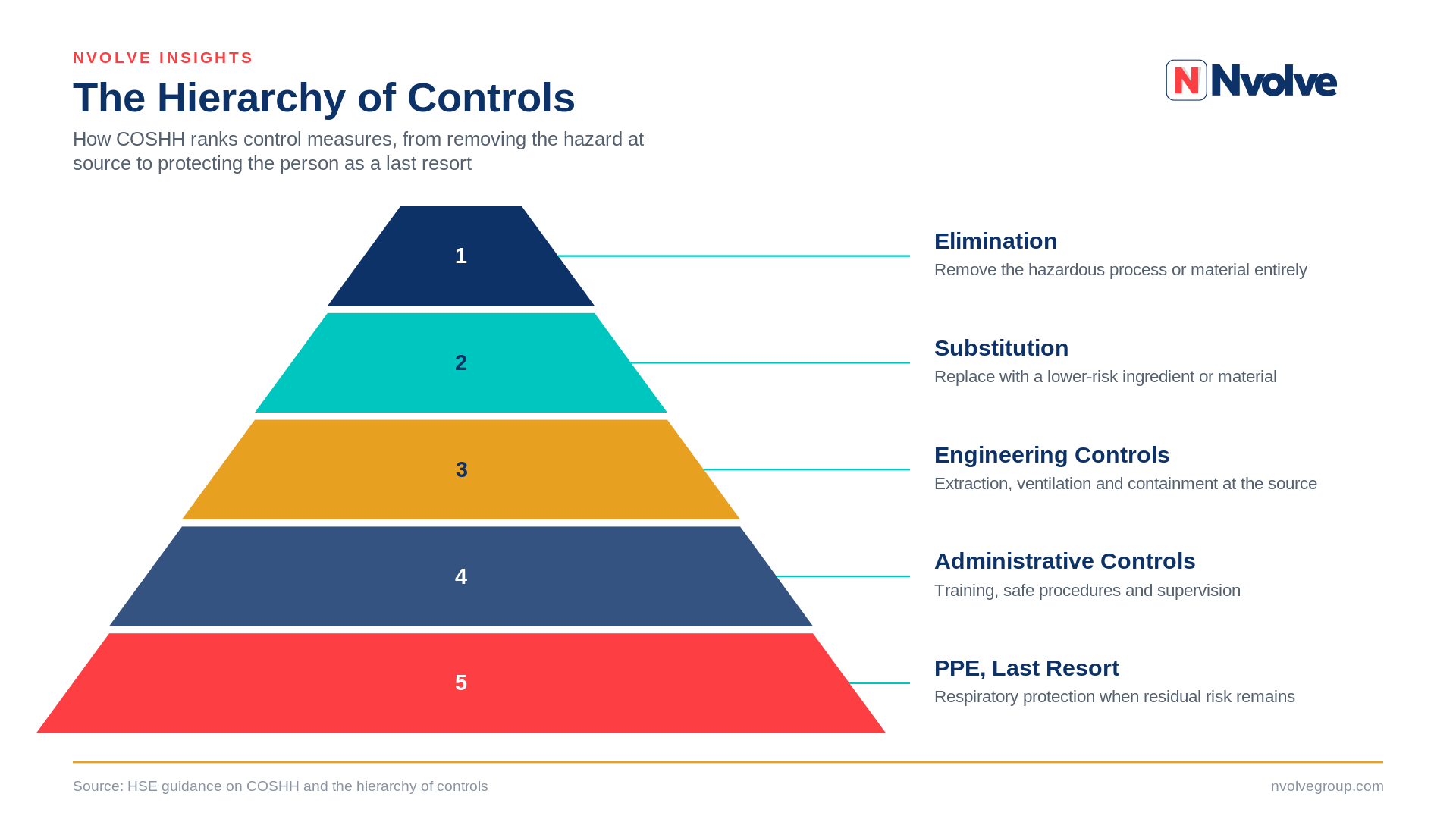
In the UK the Control of Substances Hazardous to Health Regulations (COSHH) require employers to assess and control risks arising from exposure to hazardous substances including airborne dusts like flour . COSHH mandates the application of the hierarchy of controls starting with elimination or substitution of hazardous processes where practicable, followed by engineering controls like local exhaust ventilation, and finally personal protective equipment or respiratory protective equipment only as a last resort.
Workplace exposure limits apply to airborne flour dust. The long term exposure limit is set at 10 mg per cubic metre averaged over an eight hour day, with a short term exposure limit of 30 mg per cubic metre over fifteen minutes. As flour dust is an asthmagen, exposure should be reduced as far below these limits as is reasonably practicable. Good practice should achieve levels significantly lower than the exposure limit.
Health surveillance requirements under COSHH also place on employers a duty to monitor workers’ health where there is a risk of ill health due to exposure that remains after controls are implemented. This includes respiratory checks for workers exposed to flour dust to detect early signs of sensitisation or asthma.
The Central Role of Training and Operating Procedures
While regulatory frameworks and engineered controls form an essential backbone of a robust health and safety programme, effective training and operational processes are what make controls work in practice.
Training equips workers with an understanding of the hazards, awareness of safe work practices, and the ability to recognise and respond to changes in their environment. Workers trained to handle ingredients carefully, avoid practices that generate unnecessary dust, and to use controls such as local exhaust ventilation correctly are significantly less likely to be exposed to hazardous dust levels. High quality training addresses process steps that generate dust, such as opening bags, pouring powdered ingredients, cleaning equipment and handling spills, and teaches safer alternatives that minimise airborne particulate generation.
Operating procedures should be documented, communicated and reviewed periodically so that they reflect current processes and controls. These procedures provide workers with clear guidance on how to safely open, handle and transfer dusty ingredients, how to set up and use extraction or ventilation systems, how to perform routine cleaning using methods that minimise dust dispersion, and when and how to wear respiratory protective equipment if residual risks remain.
Training is also central to proper use of respiratory protective equipment. Incorrect use of RPE such as ill fitting respirators or inconsistent wear provides a false sense of security and undermines overall risk control. Behavioural and administrative controls such as training reinforce engineering controls by ensuring workers understand why controls matter and how to maintain them.
Reinforcing the Message: Training Saves Lives and Protects Production
Regulatory inspections and exposure limits alone do not prevent occupational illness. Real reductions in risk occur when training is embedded into daily operations and adapted to the realities of production environments. In bakeries and across the wider food manufacturing sector, training is the mechanism that turns policy and equipment into lived safety outcomes.
Evidence from food manufacturing and processing environments shows that workplaces with structured, role specific training programmes achieve measurably better safety and health outcomes. Studies examining occupational asthma and respiratory illness consistently identify inadequate training and lack of hazard awareness as contributing factors to delayed diagnosis and prolonged exposure. Workers who understand early warning signs, such as persistent coughing or eye irritation, are more likely to report symptoms sooner and seek adjustments before irreversible sensitisation occurs.
Across the food manufacturing sector, training has also been shown to improve compliance with operating procedures that reduce airborne contaminants. Anonymised case studies from digital training platform providers serving large food manufacturers have demonstrated reductions in reported respiratory symptoms, fewer near miss reports linked to dusty processes, and improved consistency in the use of ventilation and extraction systems following the introduction of structured, repeatable training programmes. In these examples, employers moved away from one off classroom sessions towards continuous, role based training that reinforced safe behaviours at the point of work.
Effective training also supports supervisors and managers. When leaders are trained to recognise unsafe practices, assess whether controls are being used correctly, and intervene constructively, safety standards are upheld even during periods of production pressure. This is particularly important in food manufacturing environments where seasonal demand spikes, shift work and labour turnover can erode informal knowledge and increase reliance on temporary or less experienced workers.
Beyond bakeries, similar patterns have been observed in other food production settings where exposure to airborne particulates such as grain dust, powdered ingredients and additives is common. Facilities that invest in ongoing training programmes report fewer lost time incidents, improved audit outcomes, and better alignment with regulatory expectations. These organisations tend to integrate training with operating procedures, risk assessments and incident reporting, creating a closed loop where lessons learned are rapidly fed back into training content.
Digital and blended training approaches have further strengthened these outcomes by enabling rapid updates, consistent messaging across multiple sites, and clear evidence of competence. In regulated industries such as food manufacturing, the ability to demonstrate that workers have been trained, assessed and refreshed on critical safety topics is increasingly important. Training platforms that link learning to specific job roles and tasks help ensure that exposure controls are understood and applied consistently.
For organisations such as Nvolve, this represents an opportunity to continue to support bakeries and food manufacturers in closing the gap between regulatory intent and operational reality. By enabling structured training delivery, clear operating procedures, and real time visibility of competence and compliance, effective training systems play a direct role in reducing exposure risks and protecting worker health and prevent cases like those at the heart of this article.
Examples of Better Practice
One example of effective control measures is the adoption of low dust ingredient alternatives. Some bakeries have replaced standard flour with low dust variants, resulting in significant reductions in airborne dust levels during key processes such as sieving, tipping and mixing. In documented cases this substitution reduced reliance on respiratory protective equipment, improved worker comfort and communication, and reduced cleaning time.
Such substitution represents a clear application of the hierarchy of controls by reducing the hazard at source rather than relying solely on personal protective equipment. When combined with improved extraction and training, these measures deliver sustained reductions in exposure.
Beyond flour and food dusts, industries that have faced similar particulate risks such as wood processing and silica handling have benefited from integrated training programmes, advanced extraction technologies and strict adherence to exposure limits. Training in these sectors emphasises early hazard recognition, correct use of ventilation and behavioural change to avoid unsafe shortcuts. These principles are directly transferable to bakery and food manufacturing environments.
When Training and Controls Fail
The consequences of inadequate training and poor operational controls can be severe. Workers with long histories of flour dust exposure may develop chronic respiratory conditions that significantly affect quality of life and long term employability. In many cases symptoms progress gradually, leading to normalisation of ill health until exposure is reduced or employment changes.
Delays in recognising early symptoms, lack of effective health surveillance, or over reliance on personal protective equipment without addressing task design all contribute to preventable harm. In some circumstances poor housekeeping and dust accumulation can also create secondary hazards, including fire or explosion risks.
Conclusion
Airborne dusts such as flour in bakery environments present a clear and well established occupational health risk. Regulatory action by the Health and Safety Executive highlights the ongoing need for robust controls under COSHH and reinforces employer responsibility to protect workers.
Effective training and well designed operating procedures are central to reducing exposure, reinforcing engineered controls and translating regulatory requirements into everyday safe practice. Evidence from bakeries and the wider food manufacturing sector shows that organisations investing in structured, continuous training achieve better health outcomes, stronger compliance and more resilient operations.
Protecting those who produce food for society requires more than compliance. It requires sustained investment in training that builds competence, awareness and accountability. Comprehensive training, supported by clear processes and modern delivery platforms, remains one of the most effective tools for protecting workers and preventing occupational disease.
To find out more about how Nvolve supports food manufacturers with creating competence in operational situations, contributing to better worker protection, get in touch with our operational training solutions specialists.