


.png)

More than 130 industry professionals registered for Nvolve's September audit challenges webinar, "Navigating the True Demands of a Hardening Compliance Environment," a session built around a practical questions for food manufacturing and the wider regulated supply chain: like how quickly could your team actually put a named employee's training record in front of an auditor, right now, without warning.
Most attendees said they could produce a named record within minutes
Host Linzi Ernstzen opened the session with a poll asking attendees how long it actually took, in their most recent audit, to produce a named employee's record. Seventy-one per cent said within minutes. A further 24 per cent said within the hour. Six per cent said within half a day, and no one reported needing more than a day or being unable to produce the record at all.
Live poll screen from event
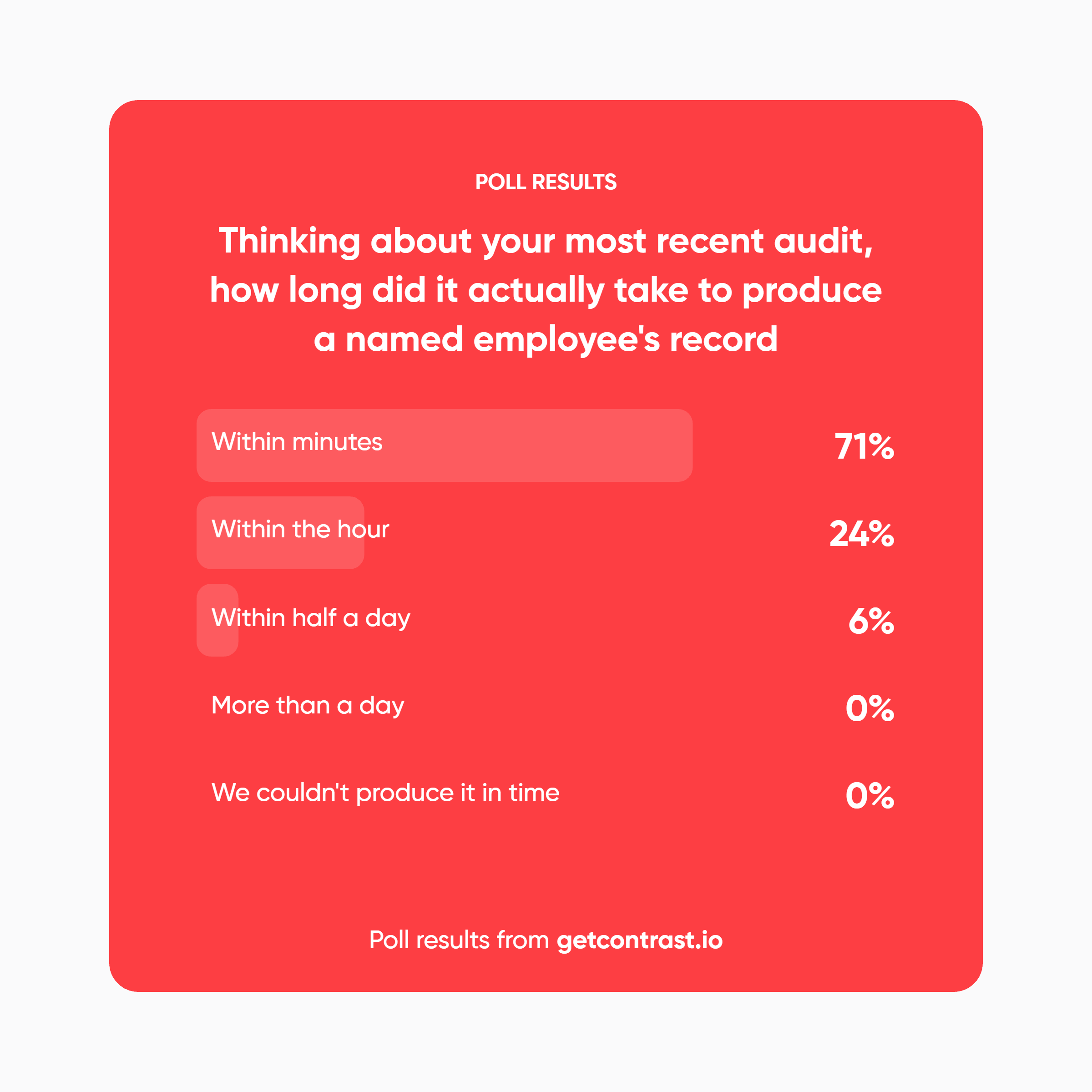
That leaves close to three in ten attendees working from a slower process, one that can turn into its own source of pressure on audit day. The panel discussion that followed put a before and after style story to that slower version, and to what changed on the other side of it.
BRCGS keeps widening what has to be evidenced
BRCGS is a GFSI benchmark standard applied widely across food manufacturing and the supply chain around it, and clause 7.1 covers training and competency specifically, according to Ernstzen. Training itself has been a requirement since Issue 8. Issue 9 widened that scope to include everyone on site, agency and contractor staff included, with allergen training now applying across that wider group too. On 10 August, four BRCGS standards were updated again to align with GFSI's 2024 requirements.
For a training coordinator, the practical effect of that widening is a longer list of things an auditor might reasonably ask for on the day, agency staff records sitting alongside permanent staff, observation checks increasingly expected in addition to a simple completion record. According to Linzi, the same direction is visible beyond BRCGS, in FSSC 22000, SQF and IFS Food alike, each are moving toward stronger controls, clearer evidence and a firmer expectation that business operations can show they are audit ready on any given day.
Linzi also cited a figure of around 185,000 non-conformities identified annually across BRCGS-certified businesses. These are businesses that already have standards, procedures and controls in place. Gaps are still being found regardless, which is evidence that having the right processes does not guarantee they are being followed consistently. Research cited during the session put the proportion of food manufacturers using digital tools for training records at just 22 per cent. Forty-eight per cent are still relying on manual spreadsheets. That figure rises to 54 per cent among small and medium-sized manufacturing plants specifically.
Visibility and expiring training are the two problems splitting the room
A second poll asked attendees to name their biggest challenge in certification or retailer audits. Visibility across sites and teams and catching training expiries in time tied at 29 per cent each. Gathering training records and evidence came in at 10 per cent. Meeting multiple audit standards simultaneously came in at 19 per cent. Counter signatures and verification came in at 14 per cent.
Live poll screen from event
.png?width=2400&height=2400&name=what-is-your-biggest-challenge-in-certification-or-retailer-audits%20(1).png)
"We're seeing a bit of a split," Linzi said, reading the results live. "Probably visibility across sites and catching training expiring in time look like the clear winners there."
A trainer's view: from a full day of dread to 40 minutes
The panel brought in Matt Jones, training coordinator at Holland's Pies, part of Boparan Manufacturing Group in Accrington, who has run Nvolve on site for just over two years. Asked what audit preparation looked like before the platform was in place, Matt's first reaction was to the poll the room had just answered.
"That poll that we've just had was really interesting for me, because I would have been clicking every single one," Matt said. "It was a mixture of all of them. It was a very stressful time when you knew the audit window was coming up."
The detail behind that admission is worth sitting with. Holland's Pies runs roughly 22 separate teams, each managing its own training paperwork, so gathering evidence before Nvolve meant physically collecting records from all 22, learning them well enough to present the next day, and hoping nothing had been missed. Matt described it as a full day's job in itself, and one that displaced whatever else he was supposed to be doing.
"By the time you actually got to the audit, it was almost a bit like being a nervous wreck, just hoping they weren't going to ask an awkward question that you hadn't got the information for," Matt said.
That changed once evidence for all 22 teams moved into one connected system. Matt described pulling together a full audit trail, records, certificates, competency checks and observation sign-offs included, in around 40 minutes, down from what had previously taken up to two hours.
"On this occasion, I think I was in the room for about 40 minutes," Matt said. "I had no qualms about letting them see the site, because I was confident in the site and in our compliance rate. I didn't have to worry about hiding it."
The dashboard test: what confidence actually looks like
That last line points at something the time saving alone does not fully capture. Matt went on to contrast his own approach with what he described as a common instinct elsewhere: at sites where the compliance rate itself is uncertain, the tendency is to control what an auditor gets to see, rather than open the dashboard and let them look. Holland's Pies did the opposite, live compliance figures on screen for the room, because the number behind them was one Matt was prepared to stand behind.
The tone of the audit changed alongside it. Matt described trying to "have a laugh and a joke" with the auditor, something he said had not happened in previous years, and put it down to how relaxed he felt walking in already knowing the answer to whatever might be asked.
None of that confidence was automatic. Matt was candid that getting there involved genuine resistance, particularly from staff who had worked at the site for decades and were comfortable with pen and paper.
The argument that shifted attitudes was not a technology pitch, according to Matt, but a demonstration of less admin and less time spent training on procedures irrelevant to a given role.
Team leaders and managers came round once they could see it working, he said, and staff are now, in his words, "well over a year in" and "feeling pretty comfortable with it."
The business continuity test: what happens when the key contact isn't there
Linzi pressed the panel on a specific question toward the end of the discussion: whether audit readiness that depends on one confident, well-prepared person is really the same thing as audit readiness that belongs to the business as a whole. Matt answered with a specific example rather than a general reassurance - framed as what happens on audit day if you're not there?
At a recent health and safety audit, Matt was not on site. In his place, Holland's Pies' health and safety manager, someone who uses the platform far less often than Matt does and holds no admin access, logged in and found everything the auditor asked for without needing to escalate the request or to wait for Matt to be reachable.
"They were still able to find everything that they needed, without having to ask too many questions," Matt said. "It shows just how easy the site is to use, that someone who isn't preparing for it can use it for their own audit, just go in on the day, find out what they need and bring it up."
We've written previously about the "guru effect", the risk that builds up in a regulated business when audit and compliance knowledge sits mostly in one person's head or one person's personal spreadsheet, and about the "bus test," a simple question asking whether a critical function still works if that person is not there tomorrow. Holland's Pies' audit continuity example here is a small, specific case of that test being passed. The evidence itself lived somewhere anyone with reasonable site access could find it, which mattered more here than whether the health and safety manager had been specifically trained to do Matt's job.
The live demo: closing the loop from finding a gap to closing it
Nvolve's Simon Ireland then walked attendees through the platform itself, starting with a multi-site compliance dashboard showing outstanding and expiring training at a glance, then into procedure version control, approval trails and a skills matrix breaking competency down by manager and by work group.
The culmination of the demonstration covered the two-step sign-off process: an employee completes training, a document review and an assessment before a manager reviews the evidence, runs an observation check and signs off separately.
Given that Matt Jones in other conversations with Nvolve has clearly said that auditors are increasingly more concerned with actual competency question content and observation checks, this helps keep pace with the hardening compliance demands.
Every step, including the observation checks BRCGS auditors are increasingly asking to see rather than a simple completion tick, then generates its own certificate and audit trail. A gap found during an internal audit, Simon showed, could be turned directly into an assigned corrective action, tracked through to a second, more senior sign-off confirming it had genuinely been closed.
Automated alerts and dashboards, or all of the above.
The final poll asked what would most immediately improve attendees' audit readiness. Fifty-seven per cent chose all of the above. Automated expiry alerts came in at 22 per cent. Digital records with counter signatures and real-time compliance dashboards each came in at 9 per cent. Version-controlled courses came in at 4 per cent.
Live poll screen from event
.png?width=2400&height=2400&name=which-would-most-immediately-improve-your-audit-readiness%20(1).png)
"I think it's pretty clear we're voting for all of the above by the vast majority," Linzi said. Read against the demonstration that preceded it, that result looks less like indecision and more like recognition: alerts, records, dashboards and version control were not shown as four separate tools to weigh up, but as views into one connected system, which may be why the room did not pick a favourite.
What the Q&A revealed
Audience questions pushed further into detail the panel had not fully covered. Asked whether supervisors and team leads sign off training themselves, Matt confirmed they do, describing it as one of the easiest parts of the system for a group with plenty of other priorities to adapt to.
Asked about his hardest moment in an audit, Matt described being questioned on allergen training given during induction, evidence he had not pre-prepared, and being able to pull the induction presentation, competency questions and sign-offs together on the spot. Before Nvolve, he said, the same request would likely have added another hour to the day. Asked where auditor expectations were heading next, Matt pointed to observation checks specifically, noting his auditor had not seen them presented this way before and suggesting other auditors are likely to start expecting the same as these systems become more common.
Where this leaves the future state of audit readiness
Matt's own closing advice on the panel was not about technology at all. Asked what he would tell someone responsible for audit preparation, his answer was to use the system every day rather than a few weeks before an audit window opens, and to get managers checking their own team's compliance rather than leaving it to one person. "The more people that are looking at it, the more gaps that get filled before you even realise that there were a gap," he said.
That advice, and the health and safety manager's audit, are really the same point told twice. The 29 per cent of attendees still struggling with visibility across sites, and the 24 per cent still taking an hour (some report up to 4 hours when records go missing) to produce a single record, are describing an event-driven process, one that switches on when an audit is announced and off again once it ends, and one that tends to depend on whoever happens to know the system best. Holland's Pies' Matt describes something closer to a habit, evidence kept current daily and accessible to more than one person, which is in no small part why 57 per cent of the room reached for "all of the above" rather than picking a singular fix towards their audit readiness .
What follows the panel in the recording is worth watching in its own right. Matt tells the story above in his own words rather than paraphrase, and Simon's demonstration is a screen-by-screen walkthrough of exactly how the evidence trail comes together, both highly useful to see first hand rather than skim read about if you are weighing this up for your own site.
The full session is available to watch now.
.png?width=352&name=Audit%20Webinar%20BlogFeature_background%20(1).png)

.png?width=352&name=GURU%20effect_LS1%20(1).png)